
From Ground to Sky: How Cabin Crew Courses Prepare You for International Aviation Standards

From Ground to Sky: How Cabin Crew Courses Prepare You for International Aviation Standards
Step onto any international flight and you’ll notice a few constants—gleaming uniforms, graceful greetings, and that unshakable poise of the cabin crew. They’re more than just the smiling faces behind the beverage cart. They are highly trained professionals who’ve spent hours, days, and months preparing to handle not only your in-flight needs but every possible scenario, from turbulence to medical emergencies. And behind that confident stride and seamless service lies something many don’t see—the intense training and global exposure they receive through institutions like Travel Learning Hub.
Today’s aviation industry is no longer local. It’s fiercely global, intertwined with international standards, cultural nuances, and safety protocols that span continents. For students dreaming of a career in the skies, the real journey begins long before takeoff. It begins in classrooms, simulations, and training labs—designed not just to teach you the ropes but to mold you into a brand ambassador of the skies.
The Sky Isn’t the Limit—It’s the Standard
International aviation doesn’t forgive the unprepared. It’s a meticulously regulated world where every gesture, word, and decision is influenced by protocols that could make or break a flight. Cabin crew training, therefore, is a blend of science and service, combining aviation law, human psychology, emergency procedures, and cross-cultural communication.
What makes institutions like Travel Learning Hub stand out is how they integrate global aviation expectations into every facet of their curriculum. Students aren’t just learning how to fasten seat belts—they’re absorbing how to remain calm during decompression, how to detect security threats without alarming passengers, and how to respond with precision during emergencies. The lessons are immersive, delivered by industry veterans who’ve lived the cabin crew life on international turf. Their stories aren’t just engaging—they’re real-world case studies stitched into the training fabric.
Where Hospitality Meets Crisis Management
There’s this romanticized idea of cabin crew being all about elegance and charm, which is only part of the story. The other part? Grit. Grit to handle medical emergencies at 30,000 feet with limited resources. Grit to manage unruly passengers diplomatically without escalating tension. Grit to represent an airline’s brand while being far from home, navigating language barriers and cultural sensitivities.
At Travel Learning Hub, this dual nature of the role is recognized and addressed head-on. Training modules don’t shy away from the tough stuff—they welcome it. You’re taught to recognize signs of passenger distress, administer CPR, handle fire situations, and assist in emergency landings. And yet, in the very next session, you’re perfecting the subtle art of first-class meal service or practicing the greeting ritual in different languages. It’s this fluid dance between grace and grit that makes the training so impactful.
Simulated Skies and Real-World Preparedness
You can’t prepare for the skies with textbooks alone. That’s why simulation-based learning is at the heart of Travel Learning Hub’s cabin crew courses. Walk into their training labs and you’ll find full-scale mock aircraft cabins where students learn to operate doors, slide deployments, intercom systems, and galley equipment. There are fire drills, smoke-filled cabins, and live evacuation exercises—not just for effect, but for muscle memory. Because in a real emergency, you don’t have time to think. You act.
The training mimics real scenarios as closely as possible. Instructors observe everything—from your body language to your tone of voice—ensuring that by the time you step into an actual aircraft, you’ve already dealt with the worst-case scenarios in a controlled environment. This kind of exposure builds reflexes, confidence, and a professional edge that many employers actively seek.
Cultural Intelligence Takes Flight
When you’re flying across time zones and continents, understanding your passengers becomes just as crucial as understanding aircraft systems. International aviation is a cultural melting pot. Cabin crew members may find themselves interacting with a South Korean businessman, an Australian family on vacation, and a French honeymoon couple—all on the same flight.
Travel Learning Hub understands this global blend and makes cultural intelligence a core part of their curriculum. Students are taught to read social cues, respect customs, and adapt their service accordingly. You learn the power of gestures, the appropriateness of eye contact, and how even a simple greeting can build rapport—or damage it. There’s emphasis on sensitivity, on awareness, on inclusivity. Because in the cabin crew world, emotional intelligence is just as vital as technical knowledge.
The Power of Communication at 35,000 Feet
If you think being fluent in English is enough, think again. Communication on international flights isn’t just about language—it’s about clarity, calmness, and command. In emergencies, your voice could guide 300 passengers to safety—or cause confusion. That’s why cabin crew training programs at Travel Learning Hub drill communication skills into their students with razor-sharp focus.
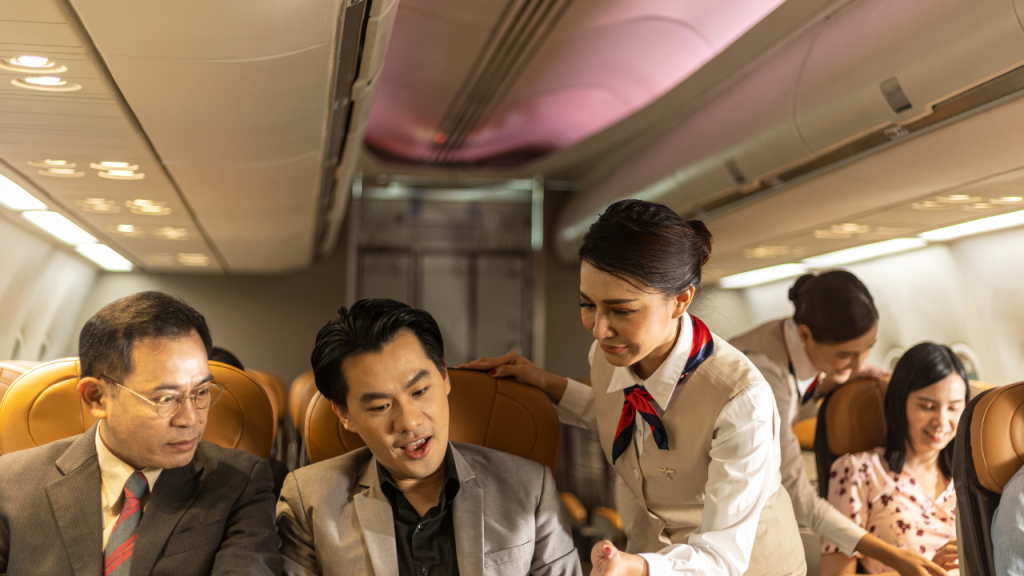
From public announcements and briefing protocols to handling panicked passengers or assertively de-escalating situations, communication is fine-tuned like a second language. Students practice tone modulation, assertive speech, and empathy-laced dialogue. They also study airline-specific jargon, ICAO phrases, and cultural sensitivities in language use. The result? Professionals who don’t just speak well—they speak with purpose.
Soft Skills That Pack a Punch
While emergency drills and aviation law are non-negotiable, it’s the soft skills that often separate a good cabin crew member from a great one. And this is where Travel Learning Hub shows its real genius. They understand that at its core, the job is deeply human. Passengers may forget the meal options, but they’ll remember how you made them feel.
That’s why students are groomed in conflict resolution, active listening, emotional regulation, and hospitality nuances. These aren’t add-ons—they’re built into the curriculum. Role-plays, real-time feedback, and situational exercises are woven into every training day. Students graduate not only knowing what to do, but how to do it with authenticity, empathy, and professionalism.
The Passport to Global Opportunities
The aviation industry isn’t slowing down—it’s diversifying. Airlines are expanding routes, adding fleets, and hiring like never before. But they’re also being choosy. They want cabin crew who are internationally polished, emotionally intelligent, and operationally ready from day one.
What sets Travel Learning Hub apart is that it doesn’t just train students for jobs—it trains them for careers. The certifications offered are recognized globally, and the institution’s placement support connects students to top international airlines. Alumni have landed roles with carriers based in the Middle East, Southeast Asia, and Europe—not because they memorized manuals, but because they embodied readiness.
There’s a quiet confidence that graduates carry—one that comes from knowing you’ve been trained not just to meet expectations, but to exceed them. That confidence speaks volumes during interviews, in the cabin, and across cultures.
The Beginning of a Journey, Not the End
There’s something poetic about it, really. Training for the skies while still grounded. It’s a reminder that every takeoff begins with preparation, with learning, with intention. For students standing at the edge of their aviation dreams, the choice of where to begin is everything.
Travel Learning Hub isn’t just a place that teaches cabin crew protocols. It’s a launchpad—a space where ambition meets structure, where dreams are given shape, and where students walk in with curiosity and walk out with capability. Whether you dream of working with a legacy airline or experiencing life across continents, it equips you with the knowledge, the demeanor, and the international edge to thrive.
And the best part? It doesn’t feel like school. It feels like transformation.
Suggested Reading: Developing Leadership Qualities Through Effective Communication
Conclusion: More Than a Course—A Mindset Shift
Becoming cabin crew is not about learning a script and wearing a smile. It’s about adapting to a world that’s fast-paced, diverse, and unpredictable. It’s about being the calm in the storm, the grace under pressure, the quiet strength that passengers don’t even realize they’re relying on. And in this global theatre, the quality of your training is everything.
For students serious about aviation, Travel Learning Hub isn’t just an option—it’s the answer. With their industry-aligned programs, immersive training environments, and a philosophy that blends heart with discipline, they’re shaping a new generation of cabin crew—ones who don’t just work in aviation, but elevate it.
If your heart beats faster every time you see a plane take off, if you imagine yourself gliding down the aisle with purpose and pride, then your journey doesn’t start at the airport. It starts at https://travellearninghub.com/. Explore their cabin crew courses and discover what it really takes to soar.
Tags
About The Author