
Diploma of Travel and Tourism: Build a Successful Career in the Travel Industry
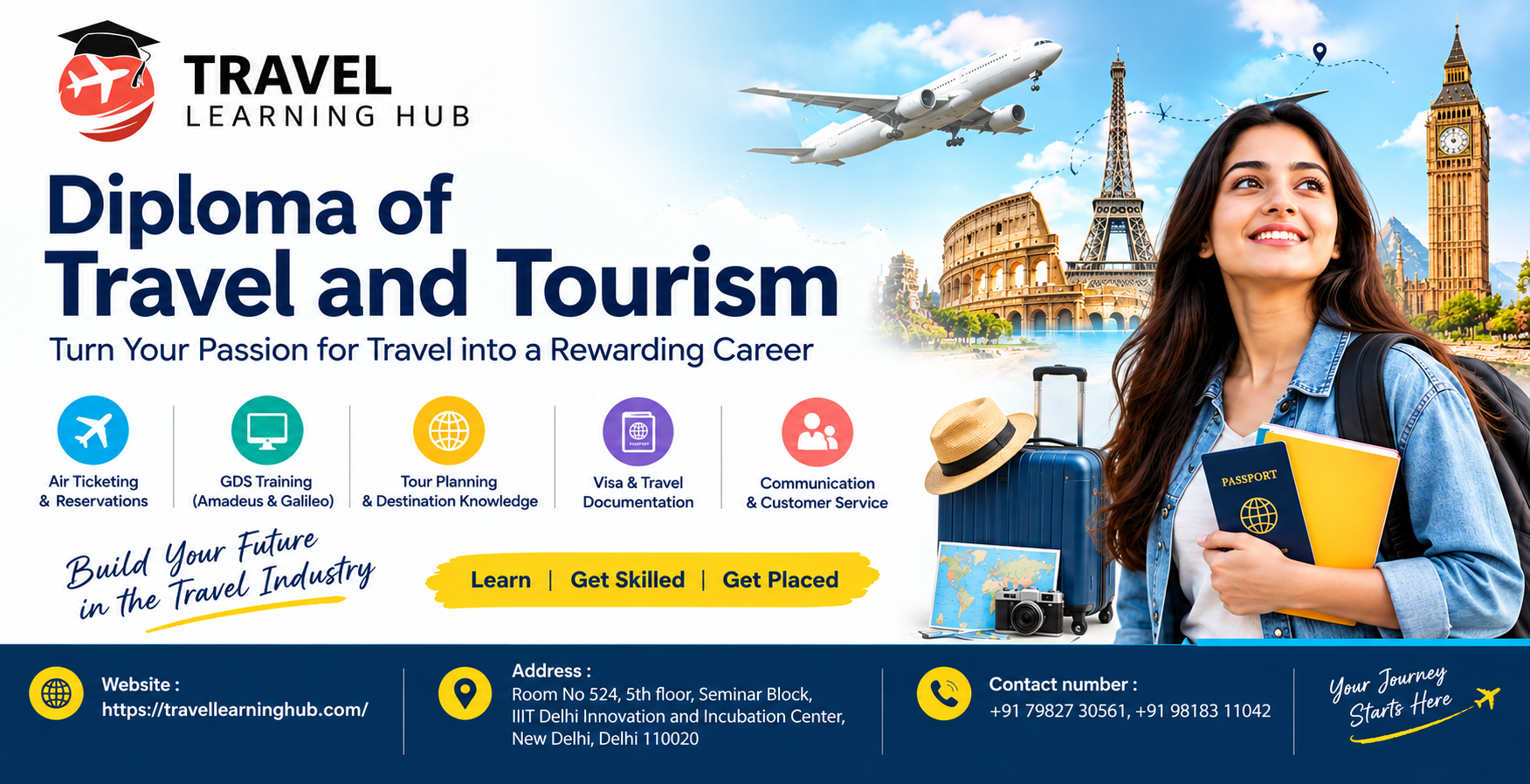
Diploma of Travel and Tourism: Build a Successful Career in the Travel Industry
The travel and tourism industry is much more than travelling to new destinations. It is a dynamic industry that brings together airlines, airports, travel agencies, tour operators, hotels, cruise companies, destination management companies, online travel platforms and tourism businesses.
For students and aspiring professionals who want to build a career in this exciting industry, a Diploma of Travel and Tourism can provide a strong foundation in travel operations, tourism, customer service and industry practices.
If you are looking for a practical, career-oriented course after 12th or want to enter the travel industry with professional training, this diploma can help you understand how the industry actually works and what skills employers look for.
What Is a Diploma of Travel and Tourism?
A Diploma of Travel and Tourism is a professional programme designed to introduce students to the different functions of the travel and tourism industry.
Unlike a course that focuses only on tourism theory, a career-oriented diploma can cover practical areas such as:
- Travel and tourism fundamentals
- Airline and airport operations
- Air ticketing and reservations
- GDS systems
- Tour planning and itinerary preparation
- Domestic and international destinations
- Visa and travel documentation
- Travel insurance and foreign exchange
- Customer service
- Travel sales
- Tour operations
- Communication and professional skills
The objective is to help students understand the complete travel ecosystem and develop skills that can be applied in real-world travel jobs.
Why Choose a Diploma in Travel and Tourism?
The travel industry offers a wide variety of career paths. You do not necessarily have to choose only between working for an airline or becoming a travel agent.
A trained travel professional can work across several areas, including travel sales, reservations, tour operations, destination management, airport services, MICE, travel technology and tourism businesses.
A diploma can be particularly useful for students who want a shorter, practical and industry-focused learning pathway.
1. Learn About the Complete Travel Industry
A good programme introduces students to different parts of the industry instead of limiting learning to one area.
You can understand how airlines, travel agencies, tour operators, airports, hotels, destination companies and other travel businesses work together.
2. Develop Practical Travel Skills
Travel is a highly operational industry. Professionals need to know how to handle customer enquiries, prepare itineraries, make reservations, understand travel documentation and communicate effectively.
Practical training can therefore be an important part of a travel and tourism diploma.
3. Learn GDS and Air Ticketing
Global Distribution Systems, commonly known as GDS, are important technology platforms used in the travel industry.
Training in systems such as Amadeus and Galileo can help students understand airline reservations, PNR creation, availability, fare-related processes and ticketing workflows.
Travel Learning Hub incorporates practical GDS and air-ticketing training into its travel-industry education approach.
4. Improve Communication and Customer-Handling Skills
Travel is a people-oriented industry.
Whether you are working with an individual traveller, a corporate client, a family planning an international holiday or a tour group, communication skills are essential.
Students can benefit from training in:
- Professional communication
- Customer handling
- Sales communication
- Telephone etiquette
- Presentation skills
- Interview preparation
- Personality development
These skills can make a significant difference when moving from classroom learning to the workplace.
What Do You Learn in a Diploma of Travel and Tourism?
The exact curriculum varies between institutes, but a comprehensive programme can include the following areas.
Travel and Tourism Fundamentals
Students learn the basic structure of the travel industry, different types of tourism, travel terminology, tourism products and the role of different industry stakeholders.
Geography and Destination Knowledge
Geographical knowledge is essential for travel professionals.
Students can learn about:
- Countries and capitals
- Major international destinations
- Time zones
- Airports and airline codes
- Popular tourist attractions
- Destination characteristics
- International travel routes
Destination knowledge is especially useful for professionals involved in travel sales, itinerary planning and tour operations.
Air Ticketing and Reservations
Air ticketing is one of the most practical areas of travel training.
Students may learn about:
- Airline terminology
- Flight availability
- PNR creation
- Passenger details
- Fare concepts
- Ticketing
- Reissue and refund concepts
- Airline policies
- Travel documentation
GDS Training
Practical GDS training can help students understand how professional travel reservations are handled.
At Travel Learning Hub, training includes GDS platforms such as Amadeus and Galileo, along with airline reservation and ticketing processes.
Tour Planning and Itinerary Designing
A travel professional needs to understand how to convert a customer’s requirements into a practical travel plan.
Students can learn how to:
- Design itineraries
- Select destinations
- Plan FIT and GIT tours
- Coordinate hotels and transportation
- Understand sightseeing options
- Estimate package costs
- Present travel packages to customers
Visa and Travel Documentation
International travel involves documentation and compliance requirements.
Depending on the programme, students may receive an introduction to:
- Passport requirements
- Visa procedures
- Travel documentation
- Travel insurance
- Foreign exchange
- Immigration-related processes
Travel Sales and Customer Service
Travel companies need professionals who can not only understand travel products but also communicate their value to customers.
Training in sales and customer handling can help students learn how to understand customer requirements, recommend suitable travel products, respond to enquiries and handle objections professionally.
Career Opportunities After a Diploma in Travel and Tourism
One of the biggest advantages of studying travel and tourism is the variety of career options.
Depending on your qualification, skills, experience and specialization, possible roles include:
Travel Consultant
Travel consultants help customers plan and book their trips. They may handle flights, hotels, holiday packages, travel documentation and other travel requirements.
Travel Sales Executive
Travel sales professionals interact with customers, understand their requirements and sell travel products such as holiday packages, flights and tours.
Ticketing Executive
Ticketing executives work with airline reservations and ticketing processes and may work in travel agencies, travel companies or other travel-related organizations.
Tour Executive
Tour executives assist with tour planning, coordination, suppliers, itineraries and customer requirements.
Destination Specialist
Destination specialists develop detailed knowledge about particular destinations and use that knowledge to help customers plan and purchase holidays.
Travel Operations Executive
Operations professionals coordinate different components of travel products and ensure that bookings, suppliers, itineraries and customer requirements are handled properly.
Airport and Airline Support Roles
Depending on additional qualifications and employer requirements, students can explore opportunities in areas such as passenger services, airport representation, airline support and customer service.
MICE and Corporate Travel
MICE stands for Meetings, Incentives, Conferences and Exhibitions.
Professionals in this segment help plan and coordinate business travel, corporate events, conferences and group movements.
Entrepreneurship
Travel education can also provide a foundation for people interested in starting their own travel business.
With appropriate industry knowledge, business planning, registrations, supplier relationships and relevant systems, professionals can explore opportunities in travel consultancy, holiday packages, corporate travel and other travel services.
Who Can Pursue a Diploma in Travel and Tourism?
A Diploma in Travel and Tourism can be suitable for:
- Students who have completed Class 12
- Graduates looking to enter the travel industry
- Freshers seeking career-oriented training
- Professionals looking to change careers
- Individuals interested in starting a travel business
- People interested in airlines, tourism, travel agencies and tour operations
The eligibility criteria, duration and certification depend on the institute and programme.
Diploma in Travel and Tourism After 12th
For students who have completed Class 12, travel and tourism can be an interesting career option because the industry combines technical knowledge with communication, customer service and destination expertise.
Instead of learning only from textbooks, students can look for programmes that provide exposure to practical areas such as GDS, ticketing, itinerary preparation, visa documentation, destination knowledge and customer handling.
This practical approach can help students understand the industry before entering the workplace.
Why Practical Training Matters
A qualification is only one part of becoming a successful travel professional.
The travel industry requires people who can actually perform tasks accurately and communicate confidently with customers.
For example, knowing what a PNR is is different from being able to create and manage one. Similarly, knowing about a destination is different from being able to design and sell an itinerary based on a customer’s budget and preferences.
This is why practical, industry-oriented training is important.
Diploma of Travel and Tourism at Travel Learning Hub
Travel Learning Hub focuses on practical and industry-oriented training for people who want to build careers in travel, tourism and aviation.
Its training approach combines travel-industry knowledge with practical exposure to areas such as GDS, air ticketing, reservations, travel operations, communication and personality development.
The institute offers travel and tourism programmes along with specialized training in areas such as GDS and air ticketing. Its website also highlights career opportunities across travel agencies, MICE, destination management, ticketing, airport services, travel portals and related travel businesses.
What Should You Look for Before Choosing a Travel and Tourism Diploma?
Before enrolling, compare programmes carefully. Consider:
1. Practical training:
Does the programme include hands-on training rather than only classroom theory?
2. GDS exposure:
Does it provide practical exposure to relevant reservation systems?
3. Industry curriculum:
Are the subjects aligned with actual travel-industry functions?
4. Faculty experience:
Do trainers understand the travel industry and its operational requirements?
5. Communication and interview preparation:
Does the programme help you develop workplace communication and employability skills?
6. Career support:
Does the institute provide placement assistance, interview preparation or industry guidance?
7. Learning format:
Check whether classroom, online or blended learning is more suitable for you.
Is a Diploma in Travel and Tourism a Good Career Option?
A diploma can be a useful starting point for someone who wants to enter the travel and tourism industry, particularly when the programme combines theoretical knowledge with practical skills.
However, your long-term growth will also depend on your communication ability, technical skills, industry experience, customer-handling ability, sales skills and willingness to continue learning.
Travel is an industry that keeps evolving with technology, changing traveller preferences and new business models. Building a strong foundation and then gaining practical experience can help you develop your career over time.
Start Your Travel Industry Journey
If you are passionate about travel and want to turn that interest into a professional career, a Diploma of Travel and Tourism can give you an introduction to the knowledge and skills required across the industry.
From air ticketing and GDS to tour planning, destinations, customer service and travel operations, the right training can help you understand how the industry works and prepare for different career pathways.
Ready to explore a career in travel and tourism?
Explore the courses at Travel Learning Hub and take the next step towards becoming an industry-ready travel professional.
Travel Learning Hub
Delhi, India
Call: +91 79827 30561 / +91 98183 11042
Website: Travel Learning Hub

Tags
About The Author
Posts You might like


